Campaign measurement
See what your campaign spend delivers.
Connect campaign activity and spend to responses, qualified pipeline, and won deals. Use the results to decide where to invest next.
Open the interactive tour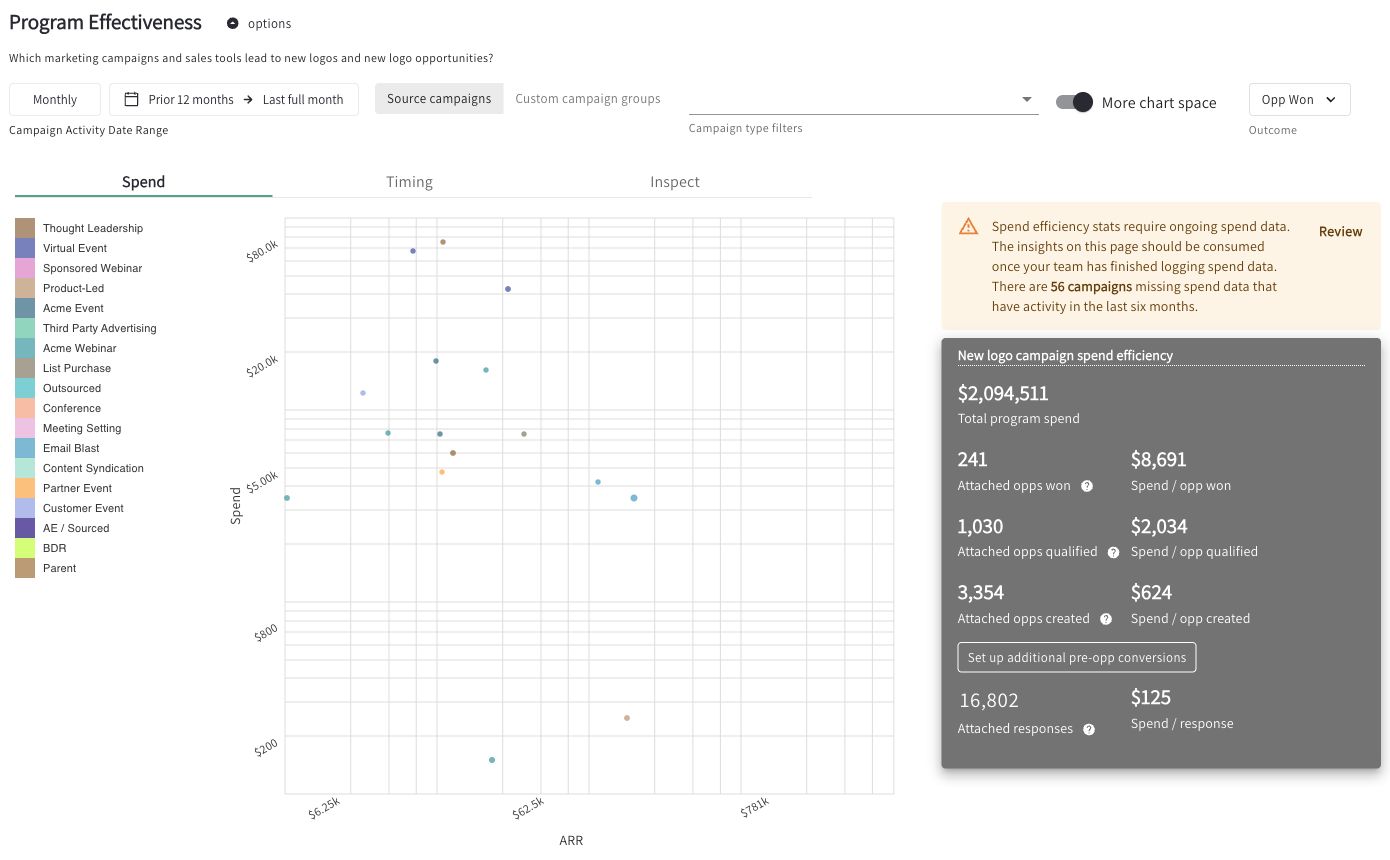
Compare recorded campaign spend with associated won ARR. Missing-spend indicators show where cost coverage is incomplete before you draw conclusions about efficiency.
Trusted by








Follow the campaign beyond the response.
Review the progression from campaign engagement to pipeline and wins. See the volume, value, and cost at each step before choosing what to scale.
Responses
Review campaign response counts and cost per response, then inspect the people behind the activity.
Qualified opportunities
Compare spend with the opportunities created and qualified. See whether engagement progresses into pipeline.
Won deals
Put associated won value and cost per win beside the investment. Open the deals behind the result.
Give each campaign the right time horizon.
Some programs generate qualified opportunities quickly. Others take longer. Compare the median, the spread of conversion times, and the number of opportunities behind each campaign type.
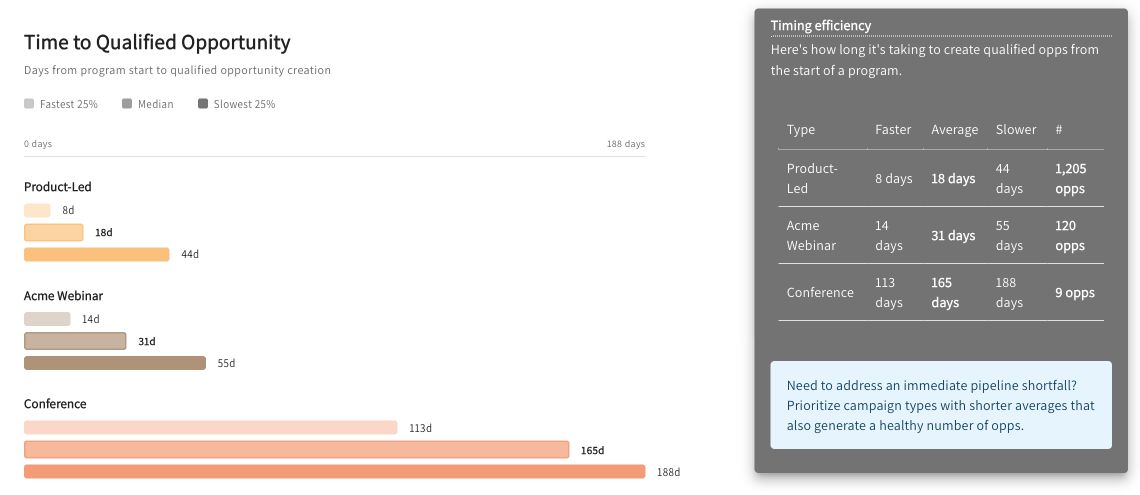
Compare how quickly different campaign types produce qualified opportunities. Read the median alongside faster and slower outcomes to set realistic pipeline expectations.
Use the timing evidence to set realistic pipeline expectations. Review campaign maturity and sample size before moving budget from one program to another.
Open the records behind the result.
A campaign total starts the discussion. Inspect the responses and related opportunities to understand the mix of activity, accounts, and outcomes behind it.
- Compare campaign types and individual campaign results.
- Inspect response records and associated opportunities.
- Review campaign interaction dates and deal outcomes.
- Bring the underlying records to the review with Sales and Finance.
Make the comparison worth acting on.
Reliable campaign decisions need maintained costs, consistent definitions, and enough time for outcomes to develop.
- Complete the costs
- Bring in campaign costs and track ongoing spend. Keep missing-spend notices visible before comparing efficiency.
- Use consistent relationships
- Apply the same contact and attribution rules across campaigns. Several campaigns can be associated with one opportunity; their totals are not automatically additive.
- Allow time for outcomes
- Compare reporting windows, conversion timing, and the number of opportunities behind each result. Recent campaigns may still be developing pipeline.
Use AI to plan the next experiment.
Bring campaign results and QFlow’s governed business context to Claude or Codex. Investigate changes, compare patterns, and draft recommendations grounded in the evidence.
Explore the related deals and available win/loss evidence to understand buyer priorities and objections. Use call recordings and notes to inform the message or audience you test next.
Explore attribution and win/loss insightsQuestions for your next campaign review
- Which campaigns generate qualified pipeline at a sustainable cost?
- Has this program had enough time to produce wins?
- What do the deal outcomes and buyer conversations suggest we should test next?
“I've rarely seen a product help usher in the type of alignment we've achieved while using QFlow.ai. The ROI has been huge, but nothing compared to the cost of inaction.”
Before your next campaign review
What can we measure for each campaign?
Review recorded spend, responses, and associated opportunities created, qualified, and won. Cost-per-response, cost-per-opportunity, and cost-per-win measures connect activity to the investment. Inspect the linked people and opportunities behind the totals.
Where does campaign spend come from?
QFlow can use recorded source-campaign costs and ongoing campaign spend entered in campaign configuration. Spend needs to be maintained for the reporting period. The report flags campaigns with activity but missing costs so you can address gaps before using the efficiency figures.
How do we compare campaigns that convert at different speeds?
Use the Timing view to compare time to a qualified opportunity, including the median, the spread of conversion times, and opportunity counts. Review those timings alongside the reporting window and campaign maturity before deciding whether a program has had enough time to produce results.
How can AI support campaign decisions?
Use QFlow's campaign results and governed business context with Claude or Codex to investigate patterns and draft recommendations. Review the related opportunities and available win/loss evidence, including call recordings and notes, when exploring buyer objections or messaging. Your team chooses the next experiment and budget decision.
Does associated revenue prove a campaign caused the sale?
No. Campaign measurement shows outcomes associated with activity under your selected relationship and attribution rules. An opportunity may be associated with several campaigns. Use the results to investigate contribution and plan tests; they do not establish incremental revenue or causal lift by themselves.
Bring evidence to your next campaign investment.
Walk through campaign spend, conversion timing, and the opportunities behind the results.